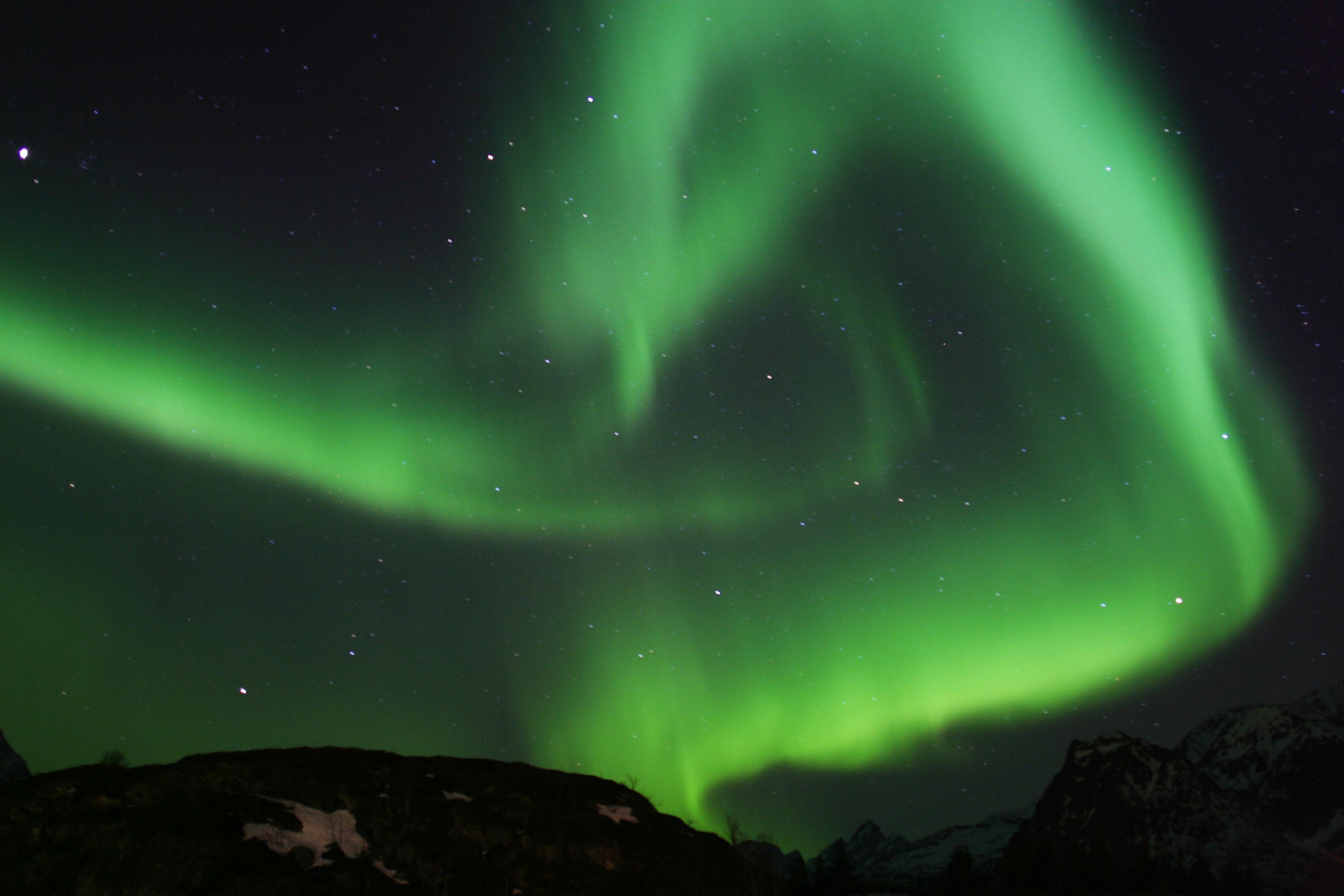
Kristian Birkeland and the Northern Lights: The Story of Haldde and Alta
Kristian Birkeland (1867–1917) was the Norwegian physicist who laid the foundation for how we explain the northern lights today: charged particles from the Sun, guided by Earth's magnetic field toward the polar regions. Much of his research took place in Alta, in Arctic Norway, where in 1899 he built an observatory on the mountain Haldde. It is regarded as the world's first permanent northern lights observatory.
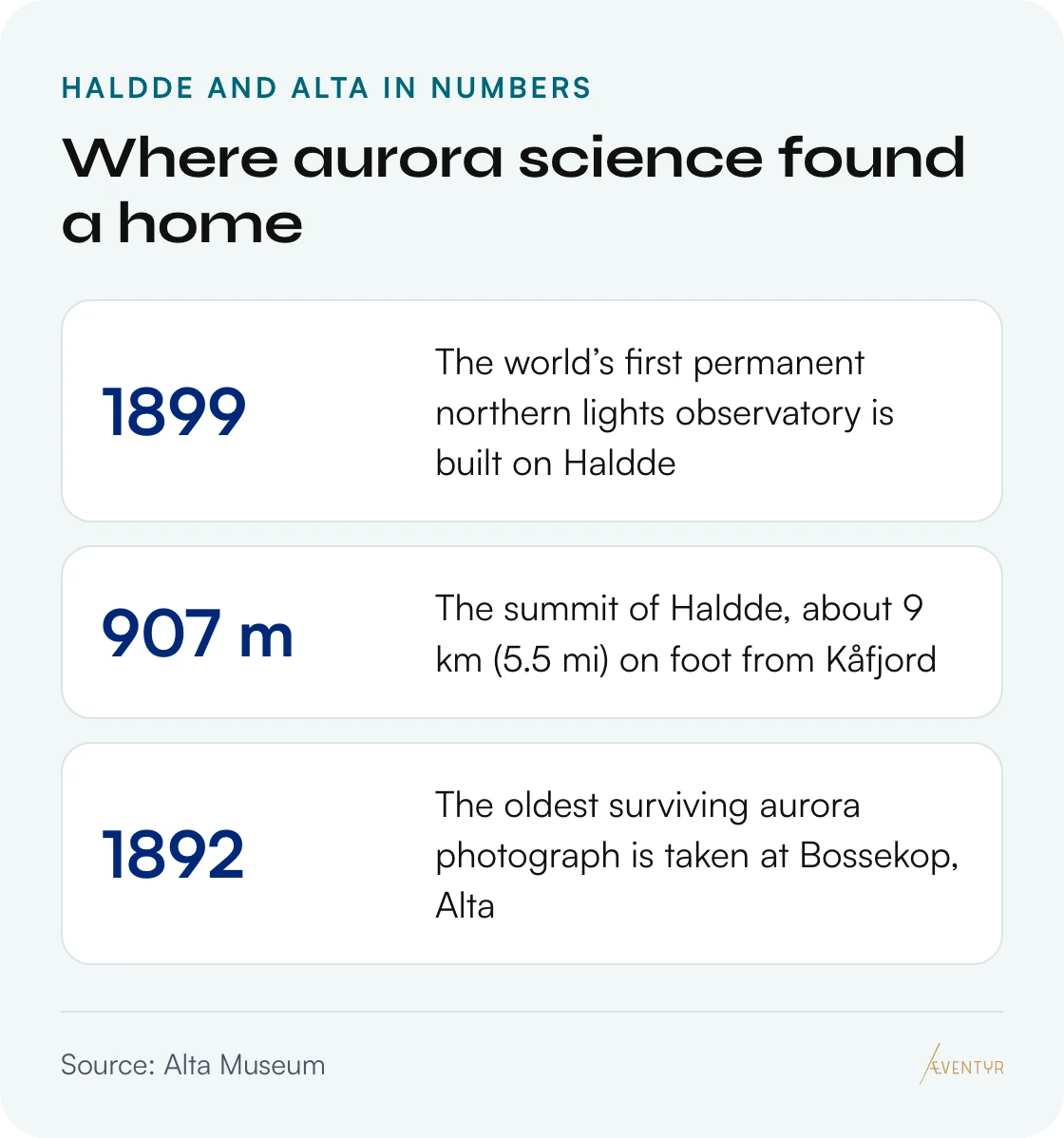
Fact box: Haldde and Alta in numbers.
Birkeland did not choose Alta by chance. By the time he arrived, scientists had been coming here to study the aurora for almost 60 years.
Why Alta became the cradle of aurora research
Alta sits directly beneath the auroral oval, the ring around the geomagnetic pole where the northern lights are most frequent. At the head of Altafjord, sheltered by mountains, the winter weather is also drier and calmer than on the outer coast. For a scientist, that means plenty of aurora and more clear nights to measure it.
Just as important was momentum: each expedition left behind observations the next one could build on. According to Alta Museum, it was precisely those early measurements that sent Birkeland straight to Alta.
Bossekop: a French expedition, a Polar Year and the oldest aurora photo
In August 1838 the French La Recherche expedition arrived to spend the winter in Alta. They had planned to base themselves in Hammerfest but chose Altafjord instead, because it had less cloud and fog. Over the winter they calculated that the aurora hung 90–150 km (55–95 miles) above the ground, and the expedition artist Louis Bevalet's paintings made Bossekop famous across Europe.
During the first International Polar Year, 1882–83, Norway placed its main station at Bossekop, and the scientist Sophus Tromholt wrote that few places could match it for observing the aurora. On January 5, 1892, the German astronomer Martin Brendel and meteorologist Otto Baschin took the oldest surviving photograph of the northern lights here, with a seven-second exposure.
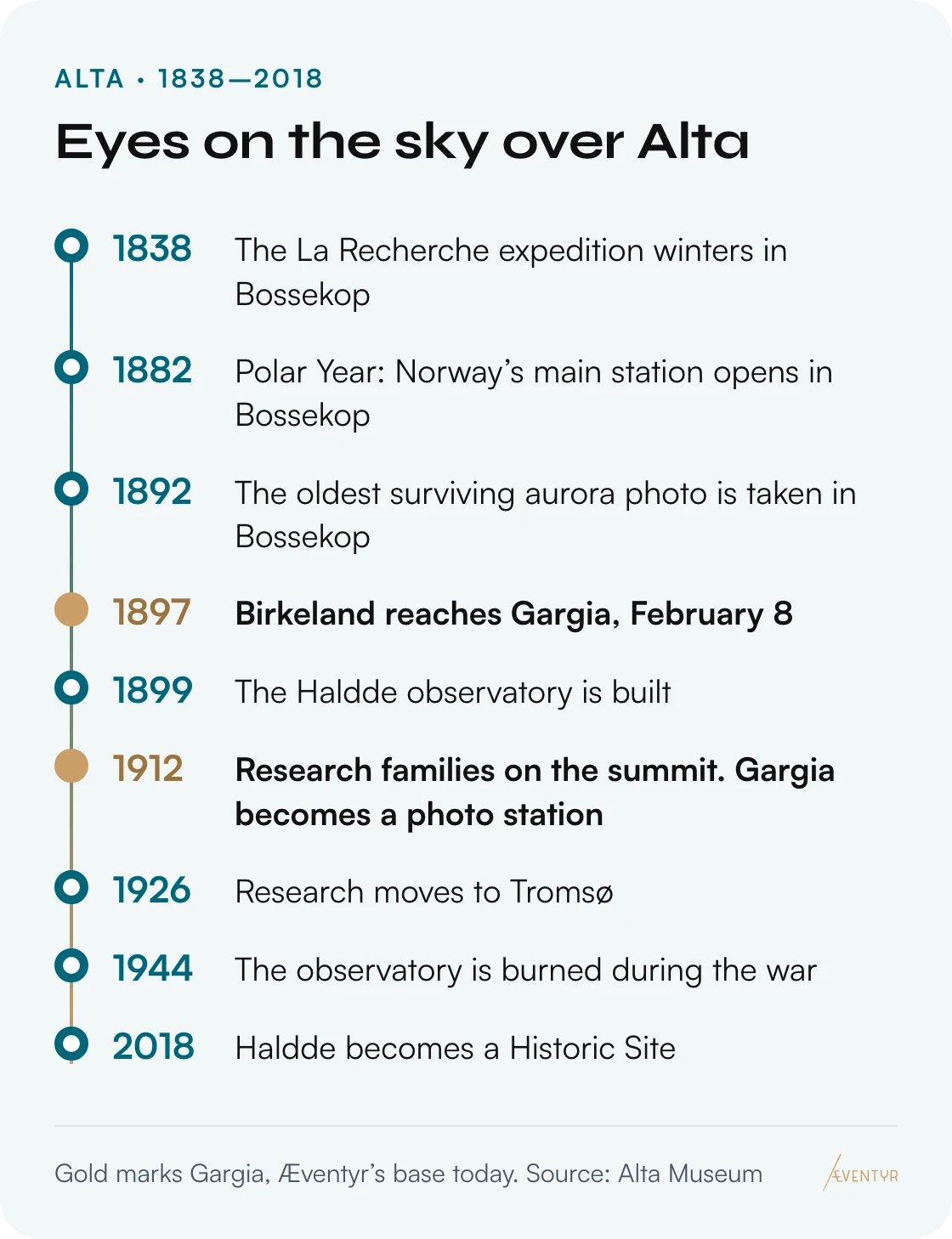
Timeline of aurora research in Alta, from the French in Bossekop in 1838 to Haldde becoming a Historic Site in 2018.
Birkeland's winter journey of 1897, by way of Gargia
Birkeland was a physics professor in Christiania, convinced that aurora research belonged on mountaintops, closer to the phenomenon itself. On February 2, 1897, he set off north with two assistants. On February 8 they reached Gargia, a mountain lodge on the edge of the Finnmark plateau. It is the same place Æventyr calls home today.
The journey nearly cost him his life. At Beskades, out on the plateau, Birkeland was caught in fierce wind and temperatures of around −25 °C (−13 °F). He came back that September and found the mountain he wanted: Haldde, roughly 900 meters (about 3,000 feet) above Kåfjord.
On a clear winter night at Gargia Lodge, it is hard not to think about him. The sky is the same one he watched, but our guests have warm clothes and a cozy lodge to come back to.
Life on Haldde, the first permanent aurora observatory
In 1899 Birkeland persuaded the Storting, Norway's parliament, to fund observatories on Haldde and on nearby Talviktoppen. He spent the winter of 1899–1900 on Haldde himself, through storms that tested both people and instruments.
The Norwegian Aurora Polaris Expedition of 1902–03 followed, centered on Kåfjord, and among the visitors to Haldde that winter was the polar explorer Roald Amundsen. Birkeland published the results in two large volumes, in 1908 and 1913.
After 1910 Haldde became a permanent observatory, partly because it could improve weather forecasts for fishermen in the north. Ole Andreas Krogness took charge in 1912 and moved up with his family, and at its busiest 17 people lived on the summit. Gargia played a part too: between 1912 and 1915 it was one of the stations photographing the aurora, with Haldde at the center.
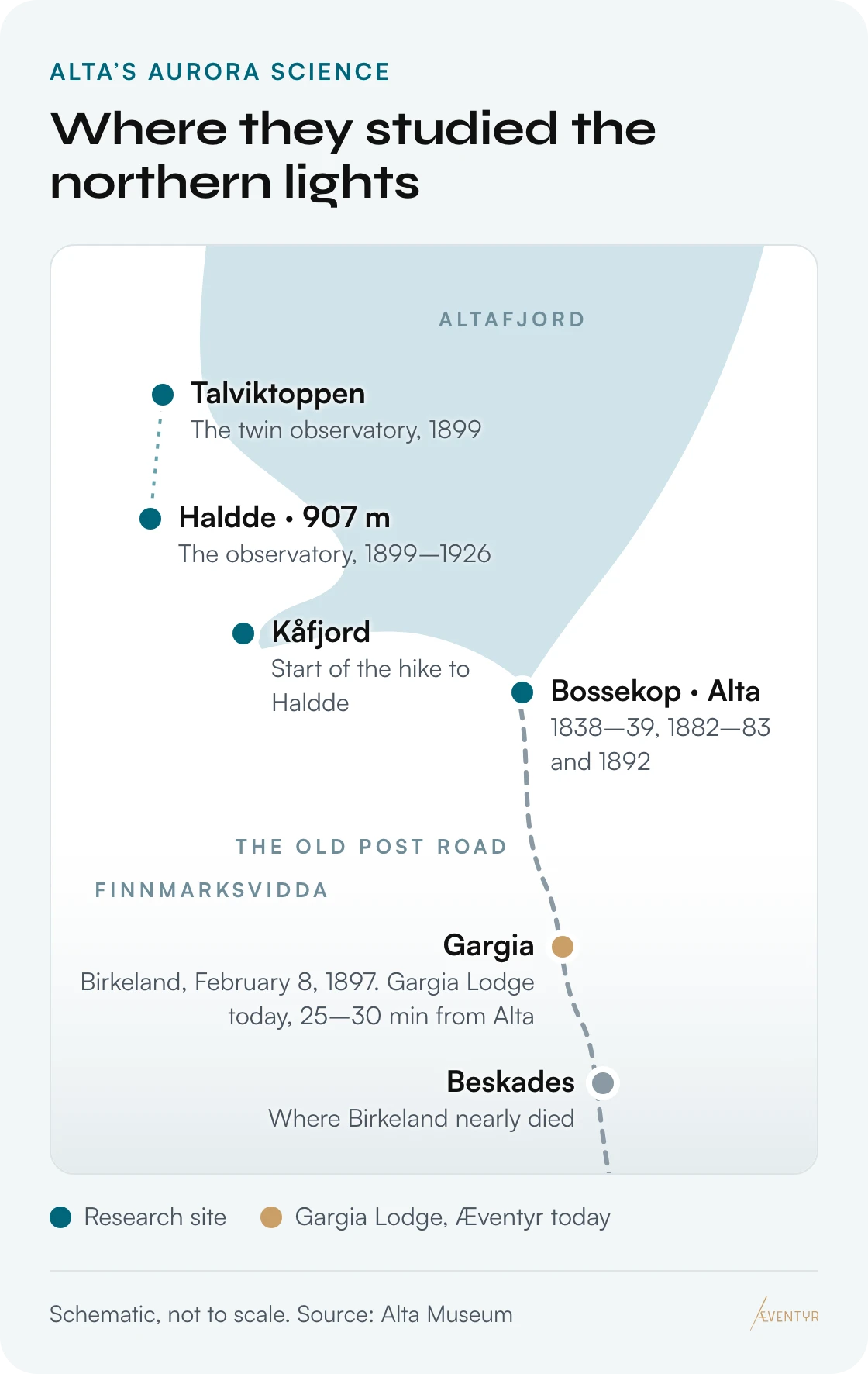
Schematic map of the research sites around Alta: Talviktoppen, Haldde, Kåfjord, Bossekop, Gargia and Beskades.
Kristian Birkeland's northern lights theory, decades ahead of its time
Birkeland argued that the aurora is caused by charged particles from the Sun that Earth's magnetic field funnels toward the poles. To prove it, he built a terrella ("little Earth"): a magnetized sphere inside a vacuum chamber. When he fired electrons at it, glowing rings appeared around its poles, a miniature auroral oval.
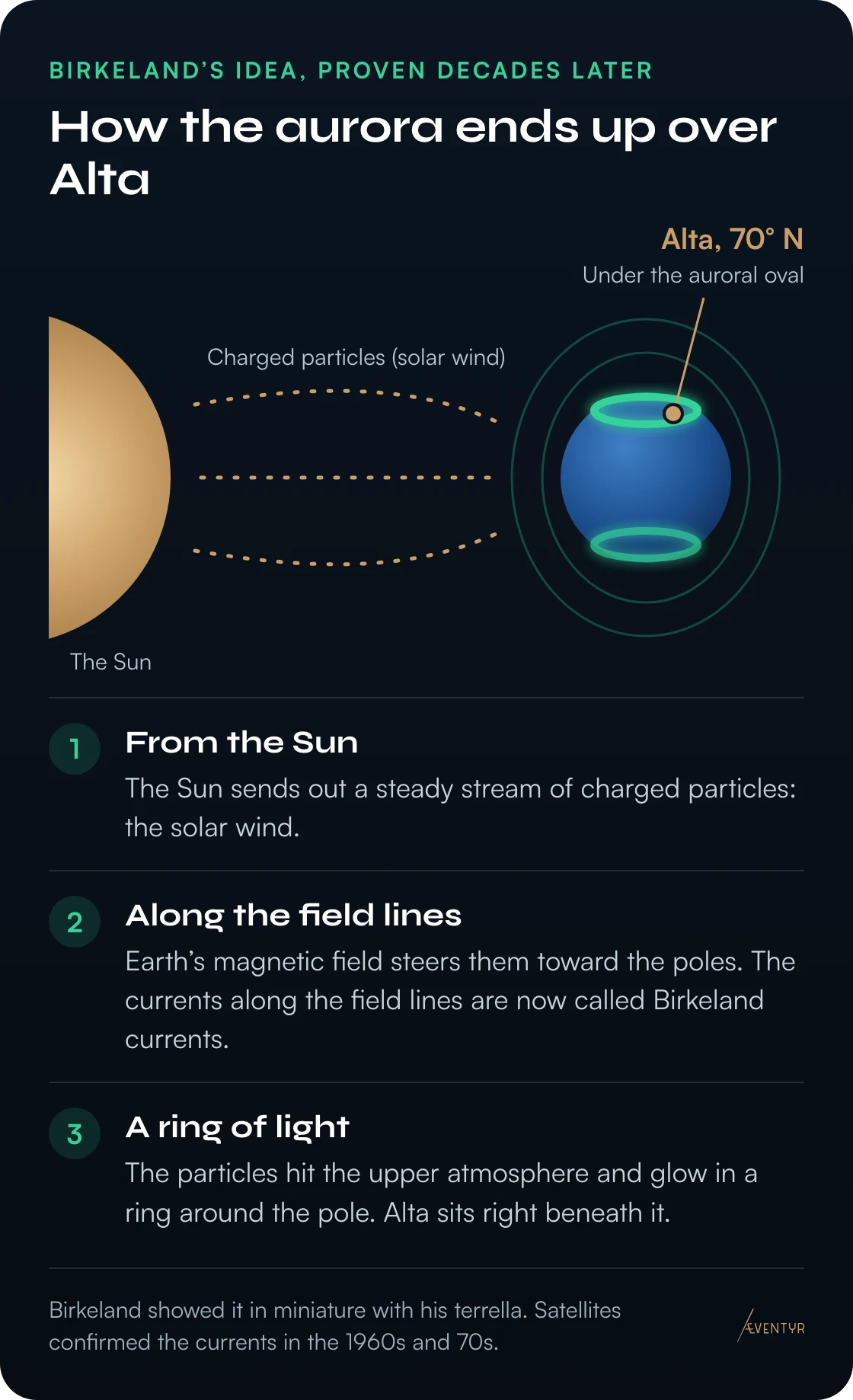
Birkeland’s aurora theory: charged particles from the Sun are steered by Earth’s magnetic field into a ring of light around the pole, right above Alta.
He also proposed that electric currents flow along Earth's magnetic field lines between space and the upper atmosphere. Many scientists rejected the idea for decades, but satellite measurements in the 1960s and 1970s proved him right. Today they are called Birkeland currents. For a clear explanation of what the northern lights are, see What Are the Northern Lights?.
Birkeland was an inventor, too: the method he developed with Sam Eyde for making fertilizer from nitrogen in the air led to the founding of Norsk Hydro in 1905. His portrait appeared on Norway's old 200-krone banknote. He died in Tokyo in 1917, aged 49.
Watch the sky over Alta right now
What Birkeland measured with instruments on a mountaintop, you can now follow from your sofa. Our cameras film the sky around the clock, so you see the aurora the moment it switches on.
Watch the live camerasClosure, fire and a second life
In 1926 the Storting voted to move the research to Tromsø, where it lives on in today's Tromsø Geophysical Observatory at UiT The Arctic University of Norway. In the fall of 1944, retreating German forces burned the observatory, and only the stone walls survived. Restoration began in the 1980s, and in 2018 the European Physical Society named Haldde a Historic Site.
Visiting the Haldde observatory today
Haldde (also spelled Halde) is now a popular hike. The marked trail follows the old cart road from the E6 highway just north of Kåfjord church, about 9 km (5.5 miles) to the observatory at 907 meters above sea level. Alta Museum puts it at around three hours up in summer at a normal pace, and the top 4 km follow the same road the scientists used more than a century ago.
- Parking: limited, near the trailhead in Kåfjord.
- Winter: parts of the route are exposed to avalanches. Check the Norwegian avalanche forecast at varsom.no, and only go with winter mountain experience and the right gear.
- Staying overnight: the oldest building, known as "Borgen" ("the Fortress"), is a self-service cabin of DNT, the Norwegian Trekking Association. You need a DNT key, and at least one person in your group must be a member. Current details are on ut.no.
- Respect the place: Haldde has long been regarded as a sacred mountain in Sámi tradition. Move quietly and leave the ruins as you find them.
Visiting Alta in winter and not up for a mountain? The Northern Lights Cathedral in town has an exhibition on Alta's aurora history.
Stand under Birkeland's sky
Alta became the cradle of aurora research for the same reasons it is a superb place to see the northern lights today: its position under the auroral oval, a drier climate and long, dark nights. Our complete guide to the northern lights in Alta has everything you need to plan a trip.
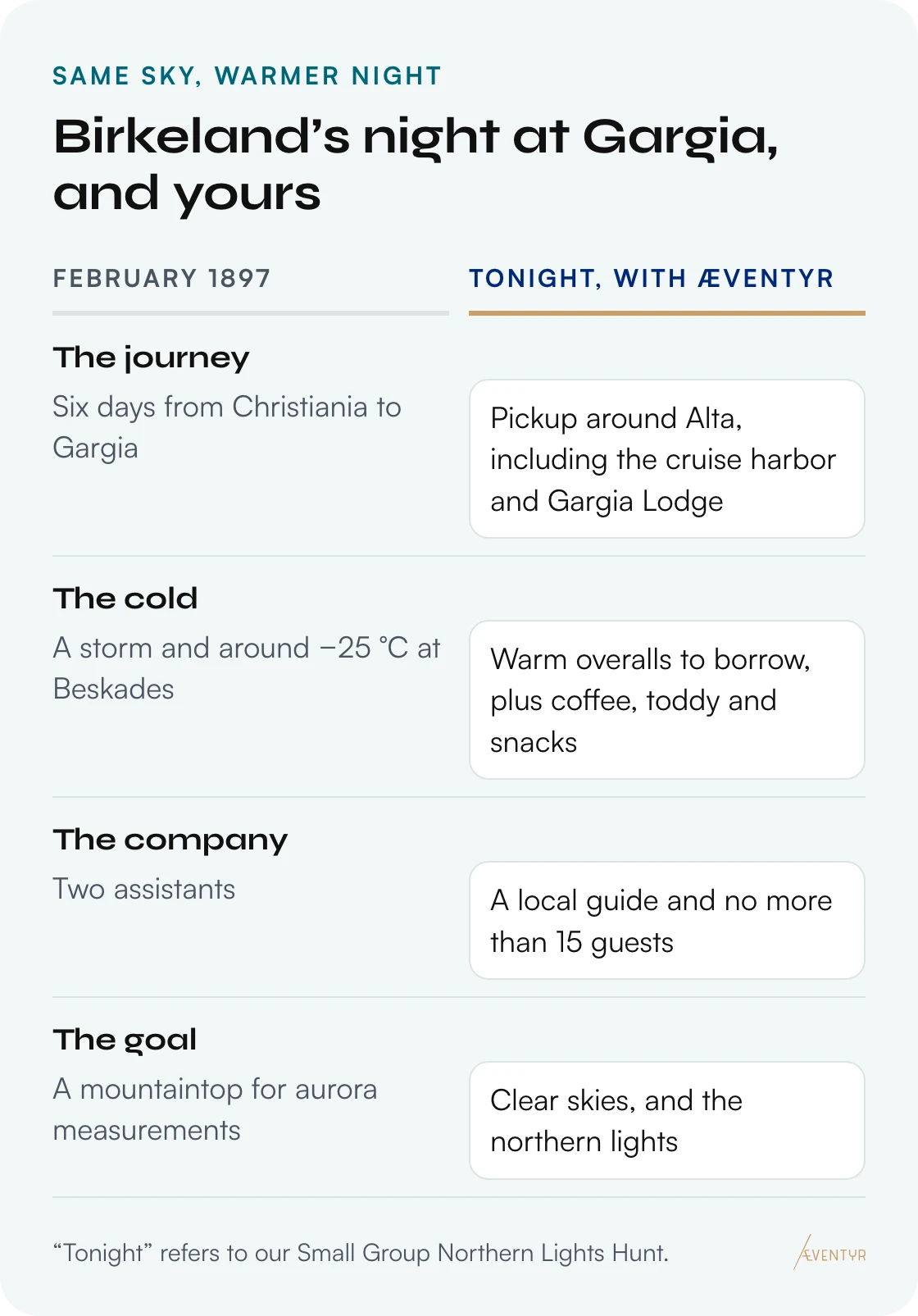
Birkeland’s night at Gargia in 1897 compared with a northern lights evening with Æventyr today.
Three ways to see the northern lights with us
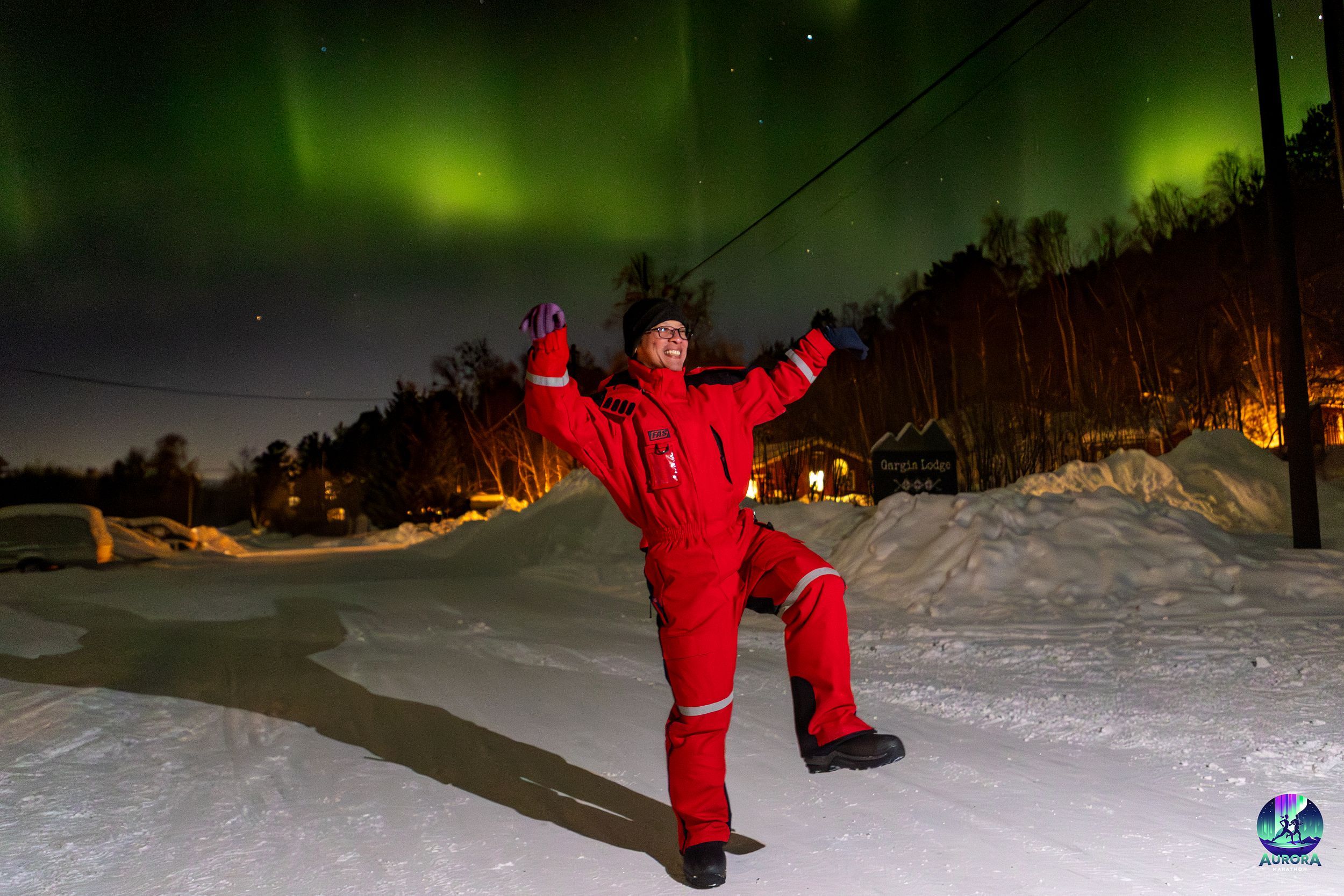
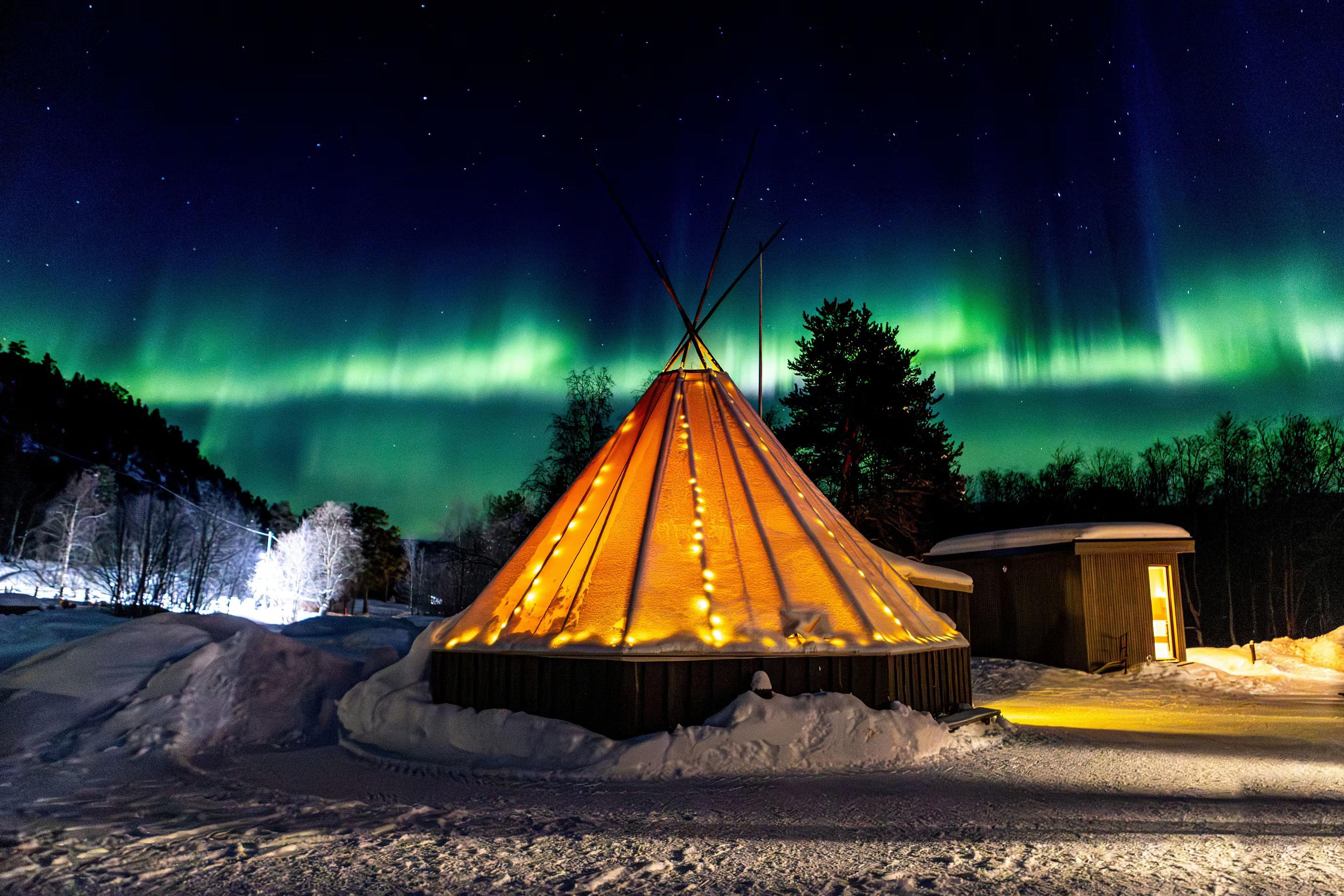
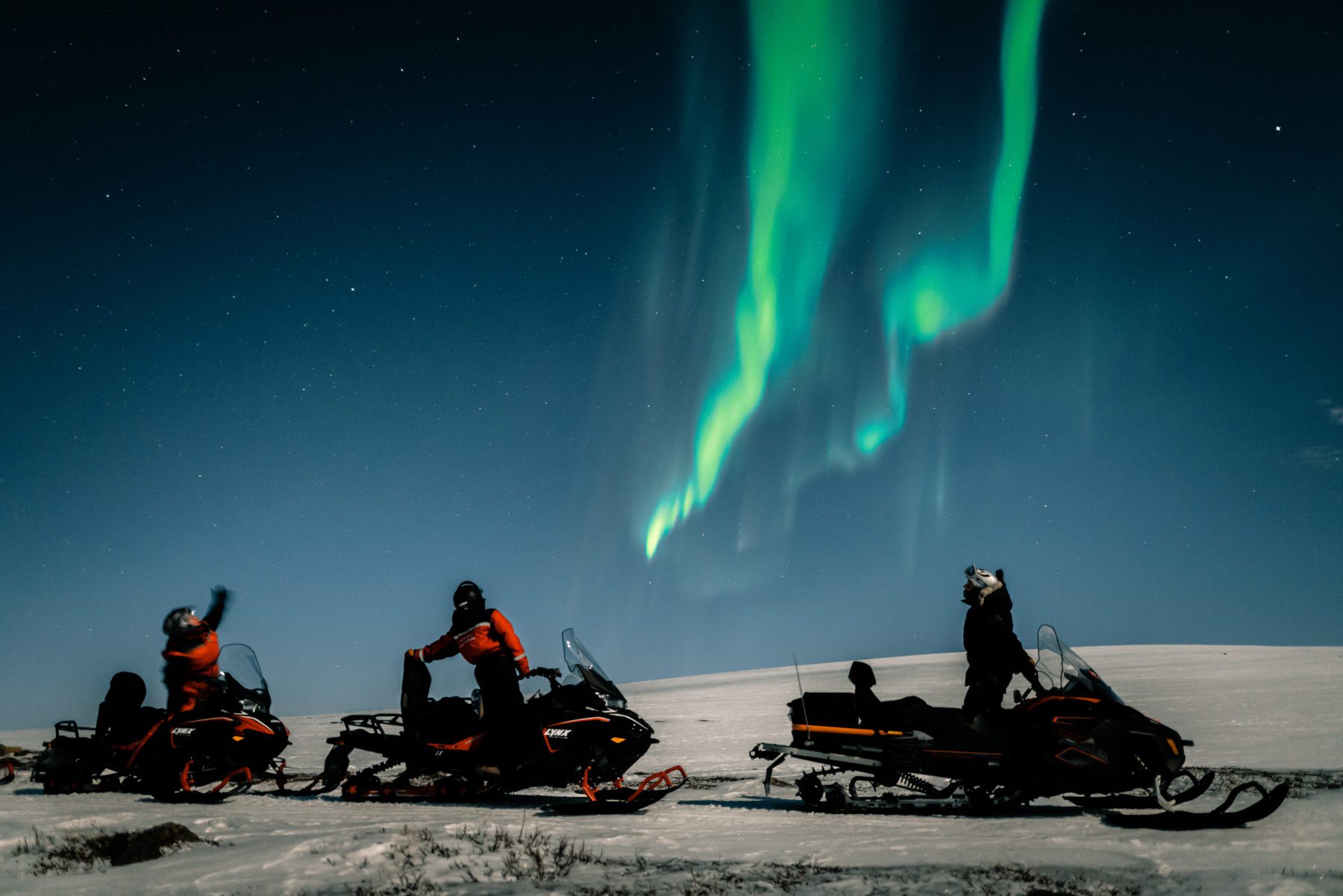
Want the night to yourselves? Request a private tour on the tour page. See all northern lights tours →
Frequently asked questions
Who was Kristian Birkeland?
Kristian Birkeland (1867–1917) was a Norwegian physicist and professor in Christiania (Oslo). He is known for his theory of the northern lights, for the Haldde observatory in Alta and for co-founding Norsk Hydro.
What did Kristian Birkeland discover about the northern lights?
Using his terrella experiments, he showed that charged particles guided by a magnetic field create glowing rings around the poles, just like the auroral ovals. He also proposed the field-aligned electric currents now known as Birkeland currents.
What are Birkeland currents?
They are electric currents that flow along Earth's magnetic field lines, linking near-Earth space with the upper atmosphere around the auroral ovals. Birkeland proposed them over a century ago, and satellites confirmed them in the 1960s and 1970s.
Your trusted guide to Arctic adventures. We specialize in creating unforgettable experiences in Alta, Norway.